Book Review Library
Book Reviews
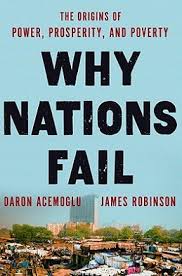
Why Nations Fail is a thought-provoking work that attempts to answer one of the most fundamental questions in global development: why are some countries rich while others remain poor? Economists and policymakers have debated this issue for decades, proposing explanations ranging from geography to culture and economic policy. However, the authors argue that the real answer lies much deeper—in the political and economic institutions that shape how societies function.
Acemoğlu and Robinson challenge many traditional explanations for global inequality. They argue that wealth differences between nations cannot simply be explained by natural resources, climate, or cultural values. Instead, they emphasize the role of institutions, the formal and informal rules that govern political power, economic activity, and social organization.
A powerful illustration used in the book is the city of Nogales, which is divided by the border between United States and Mexico. Despite sharing the same geography, climate, and culture, the two sides of the city display starkly different living standards. According to the authors, the difference arises from the institutions and governance structures of the two countries rather than environmental or cultural factors.
The central argument of the book is the distinction between inclusive institutions and extractive institutions. Inclusive institutions distribute power broadly and create opportunities for individuals to innovate, invest, and participate in economic activity. Extractive institutions, on the other hand, concentrate power in the hands of a small elite who design the system to benefit themselves while limiting opportunities for others.
The authors also address the rise of countries like China, whose rapid economic growth has led some observers to believe that authoritarian systems can deliver long-term prosperity. Acemoğlu and Robinson acknowledge that centralized authority can sometimes create stability and allow short-term growth. However, they argue that without inclusive political systems, such growth eventually reaches limits because elites prioritize maintaining power rather than encouraging innovation and broad economic participation.
One of the most compelling aspects of Why Nations Fail is its rich use of historical examples. The authors examine cases from medieval Europe to modern Latin America and Africa to demonstrate how institutional structures shape economic outcomes. These narratives help readers understand how political struggles, revolutions, and shifts in power have historically paved the way for more inclusive systems.
The book also highlights the role of political conflict and social movements in shaping institutions. According to the authors, inclusive institutions rarely emerge naturally. Instead, they usually arise when societies challenge entrenched elites and demand broader participation in governance and economic life.
Overall, Why Nations Fail is both intellectually rigorous and accessible to general readers. It offers a powerful framework for understanding global inequality and encourages readers to look beyond simple explanations. By focusing on institutions and political power, the book provides valuable insights for policymakers, students, and anyone interested in economic development.
Key Takeaways
1. Institutions Determine Prosperity: The quality of a country's political and economic institutions plays a decisive role in shaping its long-term development.
2. Inclusive Institutions Encourage Growth: When citizens have political rights, secure property rights, and equal opportunities, innovation and investment flourish.
3. Extractive Institutions Limit Development: Systems where elites monopolize power and wealth often suppress innovation and prevent broad economic participation.
4. Geography Alone does not Determine Wealth: Countries with similar geography can experience vastly different outcomes depending on their institutions.
5. Historical Events Shape Institutions: Key moments such as revolutions, colonization, and political reforms often determine the institutional trajectory of nations.
6. Political Power and Economic Power are Closely Linked: Elites who control political institutions often design economic rules that protect their own interests.
7. Economic Growth under Authoritarian Systems may be Temporary: Without inclusive institutions, long-term prosperity is difficult to sustain.
8. Innovation Requires Security and Incentives: People are more willing to invest and create when they believe they will benefit from their success.
9. Institutional Change Often Comes through Struggle: Inclusive systems usually emerge from social and political conflicts that challenge existing power structures.
10. Development is Fundamentally Political: Sustainable prosperity depends not only on economic policy but also on how political power is distributed in society.